by Glenice Lilje
Have you ever heard the expressions, the “Sunday Scaries” or that someone has “the case of the Mondays”? Have you been working from home and dread the return of the daily commute? Purchased a lottery ticket in hopes of breaking free from your 9 -5 routine? You’re not alone. There are many times where I have caught myself staring out the window, or wished I had a job that required me to travel. Although I long for a break in my predictable work schedule, changes can be daunting. Sure, I may complain about the monotony, but if I am being honest, I am nowhere ready to become my own boss take a little comfort in knowing what my work week is going to look like. But for some people working 9-5 Monday to Friday doesn’t fit their lifestyles or they find that they are most productive with a more flexible schedule. Though we can’t always be our own bosses, but we do have some control over our work environment.
Think back when the pandemic was first declared. People had to rearrange their whole lives and figure out a way to work from home, or attend school from home, and some had to become their children’s teacher while also trying to meet project deadlines. The lines between work and home became blurred and “day pajamas” entered our vocabulary. Some people lost their jobs all together and had to either figure something else out or apply for government assistance. But if you think about, it was scary, it was awkward, but it was manageable. The pandemic also provided time to take a step back to reassess and sometimes needing to readjust. For me, I wanted to put my mental health and job satisfaction at the forefront and sought resources to make my work day better. I wasn’t ready to become my own boss, but as I awkwardly navigated through the pandemic, I have been listening to myself more and made a promise to continuously reassess and adapt.
Below are some materials that suggests ways to change up the work week, vamp up your work environment or provide you with some insights to help revise your outlook and/or career goals.

Sustaining Workforce Engagement: How to Ensure Your Employees are Healthy, Happy and Productive by Lonnie Wilson, 2019.
This book explains the importance of employee engagement is for your business, how it can be achieved and how to sustain it. Lonnie Wilson takes a look into the psychological, emotional and social forces that inspires employees to become engaged and create a happy and productive workforce. Provided are ways to measure engagement, suggestions for management to help achieve or improve it, and why people can try so hard to create a fully engaged workforce with the best intentions yet still fall short. The author includes a critical and comprehensive series of discussions, looks into scholarly theories, shares experiences to help explain the mystery of achieving engagement. For Wilson, it ultimately all boils down to whether or not people are prepared for change.

No Rules Rules: Netflix and the Culture of Reinvention by Reed Hastings, 2020.
Netflix first started in 1997 as a mail-in DVD subscription-based service. Since then, it has exploded globally as a well-known content platform and production company. No Rules Rules: Netflix and the Culture of Reinvention follows founder and co-CEO, Reed Hastings, and his detailing of how Netflix created and evolved its corporate culture which fosters and environment of employee “freedom and responsibility”. This book may act as a step-by-step guide of how Hastings has restructured the typical business model and how it has helped form the basis for Netflix’s exponential growth and category-dominating position it holds today.

 I did a grad course in UBC Engineering when I was in my late 30’s. I have always valued textbooks from an educational perspective since my early education. That didn’t change, but being a mature student (read with bills to pay) I also found textbooks costly. Interesting how “valuable” may have positive or negative connotations when it comes to textbooks.
 All changed in 2018 when I adopted an OER textbook for one of my courses. The original author chose not to include chapter questions in his textbook, as he found more suitable to hand them to students directly. Upon contacting the author I decided to use his book as the main reference and complement it with extra problems that are more relevant to Power Engineers. Students currently work with both textbooks, learning from one and reviewing a summary and completing problems from my “supplement”. We have delivered the course in this format for the last 4 years and managed to improve content year after year.

 OpenEd has been an excellent gateway for me to consolidate some of the work I’ve done with drones and disseminate it to a much wider audience than previously possible. The other element is that OpenEd has allowed me to involve students, both from BCIT and from high school volunteer programs.
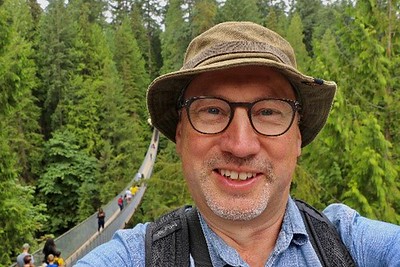 My open education journey began when I took a poll in my Astronomy 7000 class (this is an elective for engineering students taking a bachelor’s degree) and found that, on account of its cost, none of the students had bought the recommended text. To counter this, I switched to using the OpenStax astronomy text, and made a work booklet (based upon OpenStax problem and solution sets) to replace the online homework system of the previous text.
 I work as an instructor in the Renewable Resources department at BCIT and teach both the Forest and Natural Areas Management diploma and the Fish, Wildlife and Recreation diploma programs. I am a double grad from BCIT with both a diploma in Forestry and a degree in Ecological Restoration. One of the things I enjoy the most about teaching is coming up with creative and fun ways to interact and engage with the students. I have been using and creating OER’s since 2019, including a plant identification card game, a winter tree/shrub identification textbook, a series of plant ID videos and self-guided plant ID tour maps. I am passionate about sharing my love of OER’s with other people and inspire them to begin creating their own.


