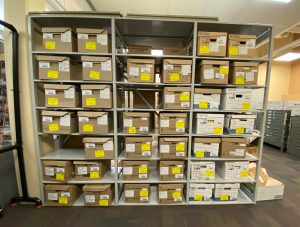
Records boxes with questionable disposition. Photo by Adrienne Chan.
Author: Adrienne Chan
The experience
From September to December 2025, I completed Professional Experience at BCIT Archives for course credit as part of my Master of Archival Studies program at UBC. My supervisor was Cindy McLellan–Librarian, Indigenous Support, IR Librarian & Archivist, Library Services–at BCIT.
BCIT Archives’ Professional Experience job posting caught my eye because of the chance to apply what I had learned in my courses, Management of Current Records and Selection and Acquisition of Archival Documents. Also, since I am considering a career in Records Management after graduation, this opportunity would be giving me hands-on experience in dealing with paper-based records.
Here is a peek at the world of records management and its connection to archives.
The task
BCIT Records Management recalled more than 75 boxes of documents from semi‐active records storage. The boxes originated from 12 different departments. While the date of the documents ranged from the mid-1970s to the mid-2010s, the bulk of them were created between 2000-2010. The documents had been sent to storage with an unclear disposition. At this stage, BCIT Archives would be assessing whether the documents’ lives would end in destruction or would continue their existence as part of the BCIT Archives holdings.
My task was to consult the Directory of Records and provide BCIT Archives with recommendations about whether to archive or destroy the documents.
The terminology
These are the definitions of the terminology introduced in the task. Definitions in this blog post were taken from BCIT’s Records Management Guidebook (2009, August).
Semi-active records
Semi-active records are records that are used infrequently by BCIT employees and contractors. They are moved from office space to lower-cost, high-density warehouse storage space.
- Did you know? BCIT pays to store its semi-active physical records offsite at a third-party storage facility.
Directory of Records
The Directory of Records is BCIT’s records classification and retention schedule. It includes classification numbers, descriptive scope notes, retention times, and disposition.
- Did you know? At BCIT, the Directory of Records can be accessed by employees through SharePoint.
Records retention
Records retention refers to the length of time records are kept until they are destroyed or transferred to BCIT Archives for long-term retention.
- Did you know? According to BCIT’s Directory of Records, course assignments and exams completed by students (with records classification series number 7010-15) are considered semi-active for one year and after said time they are destroyed.
Disposition
Disposition refers to the final outcome of BCIT records in all media formats. Two outcomes are possible: records are either securely destroyed or transferred to BCIT Archives for long-term retention.
- Did you know? BCIT has a contract with a records shredding company to ensure that records at the end of their retention period are destroyed securely and completely.
Archives
BCIT Archives is the repository of historically significant Institute records, including those created by the Institute and its employees in the course of activities and functions. These records may include reports, policy and procedure manuals, strategic planning statements, surveys, architectural drawings, minutes of Board of Governors meetings, minutes of committees and departments, financial statements, and other records of enduring value.
- Did you know? BCIT Archives is located in the basement of the library, but it is not open to the public. You can visit BCIT Archives & Special Collections’ holdings online and if you want access to materials, they could be made available upon request on a case-by-case basis. Some materials have been digitized and are available online in a searchable database.
The process
I created a spreadsheet to keep track of the identification and content of the boxes. As I progressed, I labelled the boxes to indicate which ones I had looked through. I realized early in the process that I should open the boxes by department. By doing so, I would have a better feel for why and how the department’s administrator decided which records to box up.
The results
I recommended that for approximately 75% of the boxes, the entire contents could be destroyed. The remaining boxes, though, have items which require further scrutiny. The final decisions rest with BCIT’s Archivist, Cindy. In the end, the amount of materials that will be archived will probably be about a handful of boxes.
While my task dealt with paper-based records, today, born-digital records are the bulk of what gets produced. They go through the process of classification, retention, and destruction or archiving, as well. So the next time you create a document called “Draft_Essay_Version3_Final,” think about what its fate will be in 20 years.