Sustainability

The densification of Vancouver is driving progressive planning policies - fostering opportunities for innovation around sustainable development issues.

Research Infrastructure

To evaluate green roof performance in different contexts, designs, and climatic zones, the Centre for Architectural Ecology is monitoring sites within a regional infrastructure network. This network comprises projects of various sizes, slopes, exposures, components and integrated technologies:

Green Roof Research Facility during World Urban Festival, June 2006.


BCIT Green Roof Research Facility

A dedicated Green Roof Research Facility was constructed in 2003 to evaluate green roof performance for stormwater source control and thermal efficiency. Located on the Great Northern Way campus, this sophisticated facility is situated in an urban industrial environment.

The Centre was built with the help of over 200 students from BCITs polytechnic stream, including the Architectural and Building Engineering Technology program, Carpentry, Structural Drafting, Steel Fabrication, Electrical, Electronics, Sheet Metal, Plumbing, Millwork and Finishing.

The BCIT Green Roof Research Facility is the most sophisticated facility of its kind.

Climatic Data

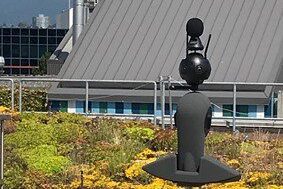
The Green Roof Research Facility is outfitted with a weather station which measures rainfall, temperature, relative humidity, wind speed and direction, and solar radiation. The three independent roof surfaces - one reference roof and two green roofs - each have their own weather poles to measure the same climatic parameters.

Roof plan showing locations of weather station, weather poles and thermal couples.

The location of the Facility is ideal for research: there are no neighbouring buildings to create microclimatic variability, and the post-industrial landscape creates the desired hostile urban environment of asphalt and gravel.

Green Roof Performance Evaluation

Performance evaluations are integral to the building envelope, and the instrumentation is embedded within the construction layers of the roofs:

  • thermal couples provide temperature readings
  • runoff drains lead to independent tipping buckets to measure runoff rate and quantity
  • heat flux transducers measure the amount and direction of energy flow through the roof
  • soil moisture meters measure the water content in the growing medium

A centralized date acquisition system collects information in real time ~125,000 pieces of data are collected every 24 hours.

To learn about our results, as well as other resources, please visit Information & Resources.


Electronic Arts Green Roof - Phase 3 (Burnaby)

The Electronic Arts Motion Capture Studio is located beside environmentally sensitive Guichon Creek in Burnaby. An extensive green roof was included in the building design to reduce stormwater runoff, and also as part of its LEED Silver certification. The green roof represents a collaborative research initiative by Electronic Arts, the City of Burnaby, and BCIT Centre for Architectural Ecology - Collaborations in Green Roofs and Living Walls.

Electronic Arts (EA) is a world leader in interactive entertainment software for personal computers, and employs over 1,000 people in the Lower Mainland. The company's research, development and head office is consolidated in Burnaby. In 2004, the City of Burnaby approved an expansion of over 18,500 m2 (200,000 ft2) of floor space. Because of its proximity to Guichon Creek, City staff worked with Electronic Arts to incorporate sustainability principles into the development, including commitments for LEED Silver standard, and green roofs.

In 2007, BCIT instrumented the 1,700 m2 (18,000 ft2 extensive green roof on the EA Motion-Capture Studeo to monitor and evaluate stormwater runoff and membrane temperatures. Preliminary data shows that the extensive green roof is extremely effective for these functions. A monumental rain event exceeding a 10 year storm occurred in September 2007, and the green roof delayed runoff for 3 hours and reduced peak flow by 90%. And over the course of the warm season, the temperature of the membrane under the green roof fluctuated by 5°C instead of the typical 41°C.

The 1,700 m2 extensive green roof on Electronic Arts Motion Capture Studio (left part of complex) has shown excellent performance for stormwater retention and detention.


White Rock Operations Centre

The White Rock Operations Building is a low-rise office building in the City of White Rock. An extensive green roof was installed and planted in 2003 to serve as demonstration, for stormwater mitigation, and for the building's LEED Gold certification. In 2007, the Centre for Architectural Ecology instrumented, calibrated and begun monitoring the 135 m2 (1,450 ft2) extensive green roof for its effectiveness as a stormwater source control tool. For the building proper, results will translate into a post-occupancy evaluation.

The arrangement with White Rock allows the Centre to assess the impacts of maintenance on stormwater runoff quality over time. With funding from Environment Canada's (EC) Georgia Basin Action Plan, this project is also exploring how the hydrological parameters of the growing medium affect the water holding capacity of the green roof. Long term observation is required for any real significant trends to be identified.

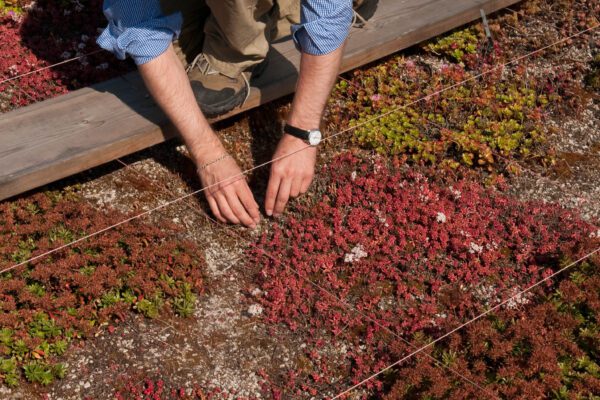
Faculty researcher Kerly Acosta monitors the green roof at White Rock.


Elevated Research Platform

The Elevated Research Platform (ERP) is a new 1,300 m2 (14,000 ft2) structure at BCIT Burnaby campus that covers the carpentry students' working area. The structure was completed in 2007, and will soon host a replicated experiment trialing native alpine plants in various substrate treatments. Because of limited loading, Phase 1 of the ERP study will be defined by four 5m x 5m plots with 75mm (3") growing media.

Thermal efficiency is not a valid parameter on a platform, so this study presents a new avenue of research for the Centre. With collaborative input from various green roof industry partners, in particular substrate and horticulture, this study will help advance our understanding of using native species in non-native environments. Concurrent with plant performance, the ERP will evaluate water retention amendments for green roof growing media, which could direct better survivability during the critical plant establishment period.

Penstemon davidsonii is one of 7 native alpine species being tested on the ERP.


Sound Transmission Facility

In order to characterize the acoustical performance of green roofs and living walls, in the fall of 2008 a new sound transmission facility will be constructed at the BCIT Burnaby campus. The sound transmission of roofs and walls are quantified by Transmission Loss (TL) - the sound reduction, measured in decibels, across a partition from the source side to the receiver side. Evaluations will be performed with an intensity measurement method in accordance to internationally accepted standards (ASTM and ISO). At the facility, 29m2 (312 ft2) exchangeable roof specimen panels (wood, steel or concrete decks with green roof variables) will constitute the roof plane of the reverberant room. The lab conditions, as well as the temperature and soil moisture of the test specimens, will be controlled and monitored.


Capital Regional District Headquarters

In partnership with the Capital Regional District (CRD), the Centre will establish a field testing site to monitor an extensive green roof, an intensive green roof and a living wall on CRD Headquarters Building in Victoria, BC. The goal of this project is to assess the effectiveness of these technologies for improving water quality, to promote best practices, and to contribute to the building's Phase 2 LEED Gold certification.

Being the first pilot test centre on Vancouver Island, the data may prove useful to other communities and jurisdictions, particularly those in the south (i.e. Nanaimo, Cowichan Valley Regional District, Ladysmith).